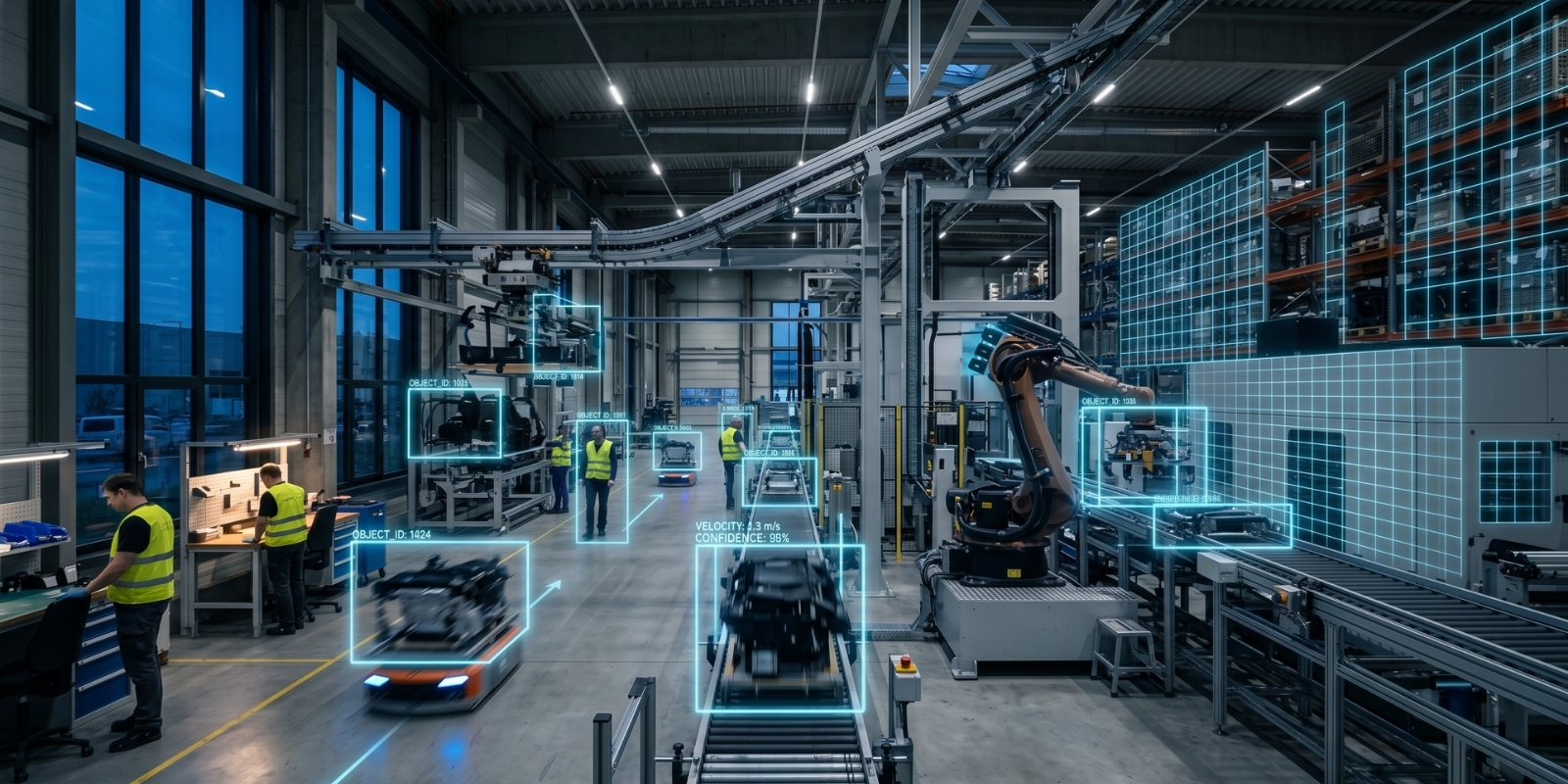
A successful computer vision solution in manufacturing, logistics, retail, and industrial operations is not defined by camera installation or model complexity, it is defined by the business event that needs to be detected and acted upon. Whether it is a defect in a production line, a missing inventory item, a safety violation, a quality deviation, or an operational delay, the real value lies in translating visual data into real-time, decision-ready business intelligence. ToCumulus takes an outcome-driven approach, working backward from the operational impact to design the full computer vision lifecycle from process discovery to model deployment and enterprise integration.
Our Great
Service
Lorem ipsum dolor sit amet, consectetur adipiscing elit. Intelligent visual systems help enterprises convert operational imagery into measurable business outcomes.
Service 01
Discover the Process
We map the workflow, pain points, constraints, success criteria, and the decision point that requires enhancement.
Service 02
Define the Visual Intelligence Task
The business problem is translated into detection, classification, counting, OCR, tracking, anomaly detection, or inspection.
Service 03
Design the Data Foundation
We define camera placement, image quality, lighting, capture strategy, edge or cloud processing, storage, labeling, and governance.
Service 04
Build the Annotation Strategy
A labeling framework is created with boxes, masks, event classes, defect taxonomies, review protocols, and validation rules.
Service 05
Train, Validate, and Tune Models
Models are trained on real data and tuned for accuracy, latency, robustness, and lower false positives and false negatives.
Service 06
Deploy Where It Matters
Inference is deployed at the edge, cloud, or hybrid layer based on latency, connectivity, security, and operational criticality.
Service 07
Integrate with Business Systems
Vision outputs trigger alerts, dashboards, incident records, ERP updates, MES events, audit logs, or quality decisions.
Service 08
Continuously Improve
Performance improves through feedback loops, drift monitoring, periodic retraining, and optimization for real-world conditions.
A camera captures what happens. Tocumulus transforms it into real-time enterprise intelligence and operational action.
Potential Computer Vision Outcomes
Computer vision, when designed correctly, is not a perception system in isolation. It
becomes a decision system where every detected event is immediately tied to
operational consequence, workflow action, and business intelligence.
• Real-time quality decisions and inspection status updates
• Production batch counts and line-level event histories
• Operator alerts, escalation triggers, and risk severity classification
• Live dashboards for operational KPIs, traceability, and performance monitoring
• Direct event integration into ERP, MES, SCADA, or HMI systems for downstream automation
Business-driven computer vision focuses on detecting real operational events—such as defects, safety risks, or inventory issues—and converting visual data into real-time business intelligence and actions.
Instead of starting with cameras or models, ToCumulus starts with the business event, identifying operational problems first and then designing AI vision systems to detect and act on them.
Common use cases include defect detection, quality inspection, safety monitoring, inventory tracking, production line monitoring, and anomaly detection in operational workflows.
Data is captured through optimized camera setups, labeled using structured annotation systems, trained with machine learning models, and deployed via edge or cloud integration into enterprise workflows.
Computer vision outputs are integrated into ERP, MES, and monitoring systems as real-time alerts, dashboards, and automated triggers for quality, safety, and operational decision-making.